

Why You Keep Rolling Your Ankle: The Science Behind Recurrent Ankle Sprains


If you repeatedly roll your ankle during sport or everyday activities, it is rarely because you simply have "weak ankles." Research shows that recurrent ankle sprains are usually the result of changes in how the nervous system, muscles, and joints work together after an initial injury.
Delahunt and Remus (2019) identify a previous ankle sprain as one of the strongest risk factors for developing chronic ankle instability. After an injury, many people experience impaired postural control, altered neuromuscular function, and reduced movement quality. These changes make it more difficult for the ankle to remain stable during running, jumping, cutting, and landing.
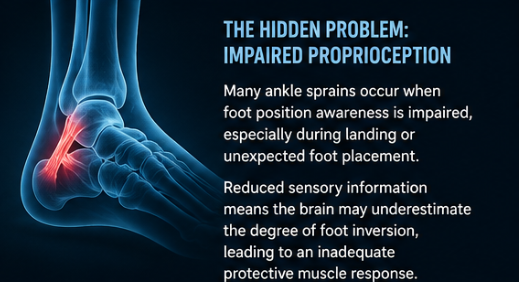
One of the key problems is a loss of proprioception—the body's ability to sense joint position and movement. Robbins and Waked (1998) suggest that ankle sprains often occur because the brain receives less accurate information about foot position before the foot contacts the ground. If the foot begins to land in an inverted position without the brain recognising it quickly enough, the muscles responsible for protecting the ankle cannot react in time to prevent the sprain.
This delayed muscle response is a major contributor to recurrent ankle injuries. When proprioception is impaired, the stabilising muscles around the ankle activate more slowly, reducing the body's ability to correct sudden movements before the ligaments are overloaded.
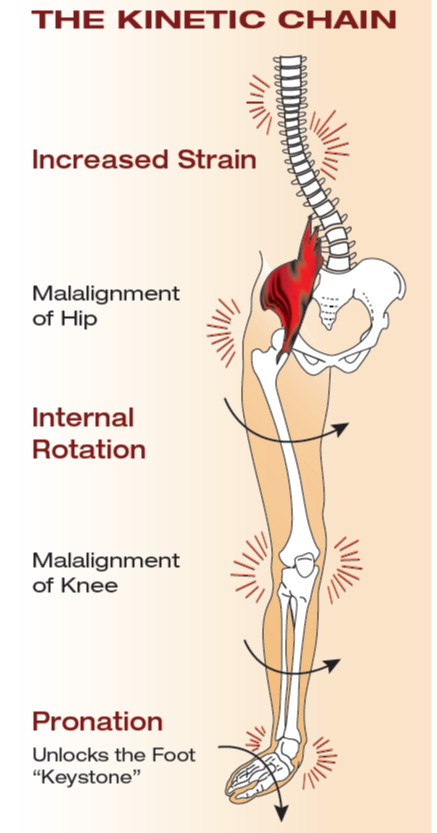
Although footwear has been suggested to influence plantar sensory feedback, it is unlikely to be the sole cause of repeated ankle sprains. Instead, recurrent injuries are usually caused by a combination of previous ligament damage, impaired proprioception, delayed neuromuscular control, muscle weakness, fatigue, and poor movement mechanics.
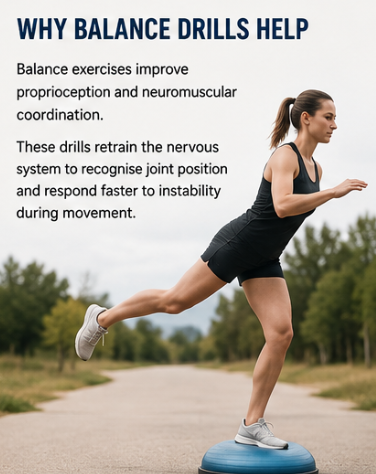
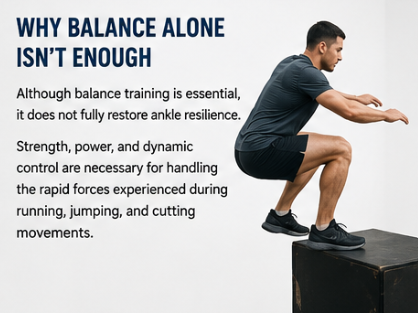
Fortunately, these problems can be improved through targeted rehabilitation. Balance exercises help retrain proprioception and improve communication between the brain and the ankle, allowing the body to recognise joint position more accurately and respond more quickly to instability. However, balance training alone is not enough.
Modern sports rehabilitation combines balance training with progressive strength exercises, plyometric training, dynamic stability work, and movement retraining. This comprehensive approach restores the ankle's ability to absorb and control the high forces experienced during sport while reducing the risk of future injury.
Key Takeaway
Repeated ankle sprains rarely occur by chance. They are usually the result of persistent changes in proprioception, neuromuscular control, strength, and movement quality following a previous injury. Addressing all of these factors through a structured rehabilitation programme is the most effective way to restore ankle stability and break the cycle of recurrent sprains.
Evidence-Based Exercises for Recurrent Ankle Sprains

Research indicates that rehabilitation is most effective when exercises are progressed from static balance, to strength and dynamic stability, and finally to plyometric and sport-specific movements. This progressive approach improves neuromuscular control, reduces the risk of recurrent ankle sprains, and supports a safe return to sport.
Key References
Delahunt, E., & Remus, A. (2019). Risk factors for lateral ankle sprains and chronic ankle instability.
Doherty, C., et al. (2017). Rehabilitation and prevention of ankle sprains.
McKeon, P. O., & Hertel, J. (2008). Systematic review of balance training for chronic ankle instability.
Delahunt, E., & Remus, A. (2019). Risk factors for lateral ankle sprains and chronic ankle instability. Journal of Athletic Training.
Robbins, S., & Waked, E. (1998). Factors associated with ankle injuries: Preventive measures. Sports Medicine.


Comments