

Does Hip Stability Matters More Than Flexibility?

Hip stability and hip flexibility are often confused, but they are not the same. Flexibility refers to an individual’s available range of motion, while stability is the ability to control joint motion under load. In clinical practice, the majority of runners we see do not lack hip range of motion; instead, they lack strength and neuromuscular control. This deficit alters biomechanics, increases compensatory movement patterns, and ultimately places greater stress on joints and soft tissues.

The Role of the Hip in Running Mechanics
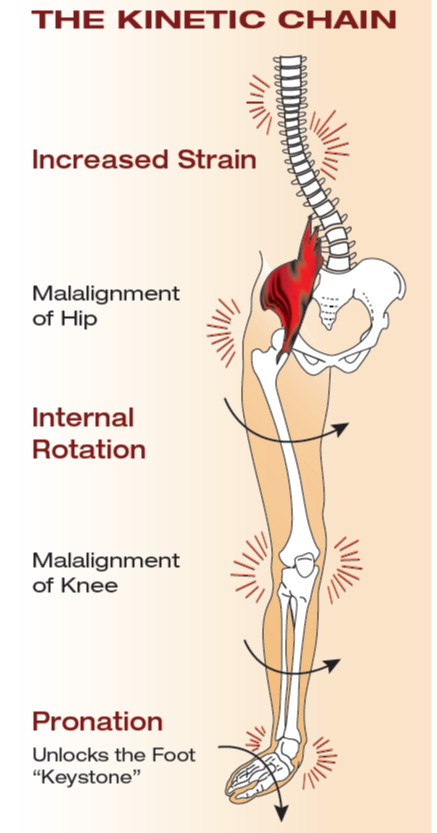
Hip stability plays a critical role during running. In single-leg stance, the hip must stabilize the pelvis while controlling femoral rotation. Poor hip stability leads to increased energy loss, reduced stride efficiency, and excessive loading of distal joints.
Weakness or hypotonicity of the gluteal muscles—particularly the gluteus medius, gluteus minimus, and piriformis—compromises hip stability. When these muscles fail to function effectively, excessive femoral internal rotation and knee valgus occur. This increases stress on the patellofemoral joint, the iliotibial band, and medial knee structures, which are common sources of running-related pain.
Lower Back Biomechanics During Running
Insufficient hip stability often results in pelvic drop and compensatory trunk movements. Over time, these compensations increase loading on the lumbar spine and contribute to lower back pain, hamstring overuse, and inefficient force transfer during running.
Spinal biomechanics and mobility also influence these compensatory patterns. Spinal rotation is a coupled motion: each vertebra contributes a small amount of movement, but collectively this creates substantial rotational capacity. If even one vertebral segment becomes restricted, overall spinal mobility decreases, leading to increased compensatory demands on the hips and pelvis and a higher risk of injury.
Why Stretching Alone Is Not Enough
Stretching temporarily reduces muscle tension by lengthening tissue, but it does not improve strength, load tolerance, or neuromuscular control of muscles and tendons. Without strengthening the hip stabilizers, runners tend to collapse into poor mechanics once fatigue sets in. As a result, stretching alone does little to prevent biomechanical breakdown during running.

Effective Hip Training for Runners Should Focus On
Strengthening the gluteus medius and maximus
Single-leg stability training
Eccentric muscle control
Pelvic alignment, especially under fatigue
Progressive load exposure
This approach improves global biomechanics and translates directly to better long-distance performance. Prioritizing hip stability over flexibility is therefore more effective for runners. Strong, well-coordinated hips reduce knee and back stress, improve running economy, and help prevent overuse and biomechanical injuries.
Stability—not stretching—is the foundation of efficient running.


Comments